An honest comparison for Pakistani students and parents: how the two routes differ in entry, duration, language, cost, clinical training and licensing, what the real disadvantages of studying in China are, and how to decide with your own numbers.
Almost every Pakistani family that considers China is also considering a seat at home. The question is rarely which one is better in the abstract. It is which one fits your marks, your budget, your appetite for living abroad, and your plan for the years after graduation.
This guide compares the two routes honestly. It uses Xinjiang Medical University (XJMU) in Urumqi as the example for China, because it is on the Ministry of Education (MOE) list of universities allowed to teach the English taught MBBS to international students, with 60 seats for 2026–2027. It does not print fee figures for medical colleges in Pakistan, because those change every year and differ from college to college. Instead it gives you a method for putting your own numbers side by side.
We also say where China is the weaker choice. A decision made with only the advantages in view tends to be regretted.
| MBBS in China (XJMU) | MBBS in Pakistan | |
|---|---|---|
| Admission basis | 60% in each science subject, age 18 to 35, documents and application | Entry test and merit, as set out in each college prospectus |
| Language of teaching | English, with Chinese taught for clinical work | English |
| Duration | 6 years including a 1-year internship | Five-year MBBS, followed by house job |
| Approval of the programme | MOE list, 2026–2027 (XJMU is number 8) | Recognised by the national regulator |
| Seats | 60 for international students at XJMU | Limited and competitive; see each prospectus |
| Home licensing | Licensing examination required for foreign graduates | Registration through the national regulator |
| Distance from home | About 2 hours 50 minutes by direct flight from Islamabad | Within the country |
In Pakistan, a place in a medical college depends on an entrance test and a merit ranking, and the number of seats is small compared with the number of applicants. Students with strong marks can still miss a seat at a public college by a very small margin, and for many families a private college is the alternative.
At XJMU, admission is based on your senior high-school results and your documents. The published requirements are a senior high-school certificate with science subjects, a minimum of 60% marks in each of the science subjects, an age between 18 and 35, good health and a valid passport. The published requirements do not include a Pakistani entrance test.
It does not mean that China is an easy route. The programme is six years of demanding medical study. Easier entry only changes the first step; it does not change what you must learn.
Whether Pakistan's medical regulator requires anything of students who study abroad, and what it requires of foreign graduates who return, is decided by the regulator and changes from time to time. Read its current rules before you pay any fee.
The MBBS in China lasts six years, including a one-year clinical internship. The MBBS in Pakistan is a five-year degree, followed by a house job.
That difference is smaller than it looks. In China, the sixth year is already a clinical year in the hospitals, so much of what a house job teaches at home is built into the degree. After graduating in China you must still pass the licensing examination for foreign graduates before you can register at home, and you should allow time to prepare for it. A realistic comparison therefore counts from the day you start to the day you can practise with a licence, not from the day you graduate.
Write each route as a timeline: years of study, internship or house job, examination and the wait for registration. Use the regulator's current rules for the examination. Then compare the two lines. For some students the China route is a little longer, and for others the wait for a seat at home makes it shorter.
Cost is the main reason families look abroad, and it is also the area where comparisons are most often misleading. A low headline fee can hide hostel, insurance and examination charges, and a high one can include them.
These are the published figures for XJMU, for the September 2026 intake. Fees for 2027 have not been announced.
From the second year, fees are about ¥35,950 a year, about USD 5,050, as itemised below.
| What the first-year package covers | Status |
|---|---|
| Application processing, registration and admission charges | Included |
| Tuition fee | Included |
| Hostel accommodation | Included |
| Student visa, health insurance and medical | Included |
| JW202 visa letter and airport pickup | Included |
| Total: ¥49,950 (about USD 7,000) |
Adding the first-year package of ¥49,950 and five later years of about ¥35,950 gives about ¥229,700, roughly USD 32,000, for tuition, hostel, insurance, residence permit and examinations over six years at 2026 figures.
Food, flights, personal spending, any increase in fees, and the cost of preparing for and sitting your licensing examination at home. Food in Urumqi is about USD 150–250 a month, local transport USD 10–20 and a mobile SIM USD 10–15.
Take the prospectus of each medical college you could realistically get into. For each year, write down tuition, hostel or travel, books and any other charges, then add the house job period. Convert the China figures at the exchange rate on the day you pay. Do the same arithmetic for both routes, and leave out nothing on either side.
| Item | Amount (RMB ¥) |
|---|---|
| Tuition fee | ¥30,000 |
| Accommodation | ¥4,500 |
| Insurance | ¥300 |
| Residence permit | ¥800 |
| Physical examination | ¥350 |
| Total per year: ¥35,950 (about USD 5,050) |
Use this table to compare your actual options. The China column is filled in from published 2026 figures. The Pakistan column is for you to complete from the prospectus of the college you are considering.
| Line | XJMU, China (2026 figures) | Your Pakistan college |
|---|---|---|
| First-year fees | ¥49,950 (all-inclusive package) | Write from the prospectus |
| Years 2 to 6, per year | ¥35,950 | Write from the prospectus |
| Hostel | Included in the fees | Write from the prospectus |
| Insurance and residence permit | Included in the fees | Not applicable, or write from the prospectus |
| Food, per month | USD 150–250 | Estimate yourself |
| Flights home | Your own ticket; about 2 h 50 min from Islamabad | Local travel |
| Licensing examination preparation | Required for foreign graduates | Not applicable |
| Total over the whole degree | About ¥229,700 plus living costs | Add up the column |
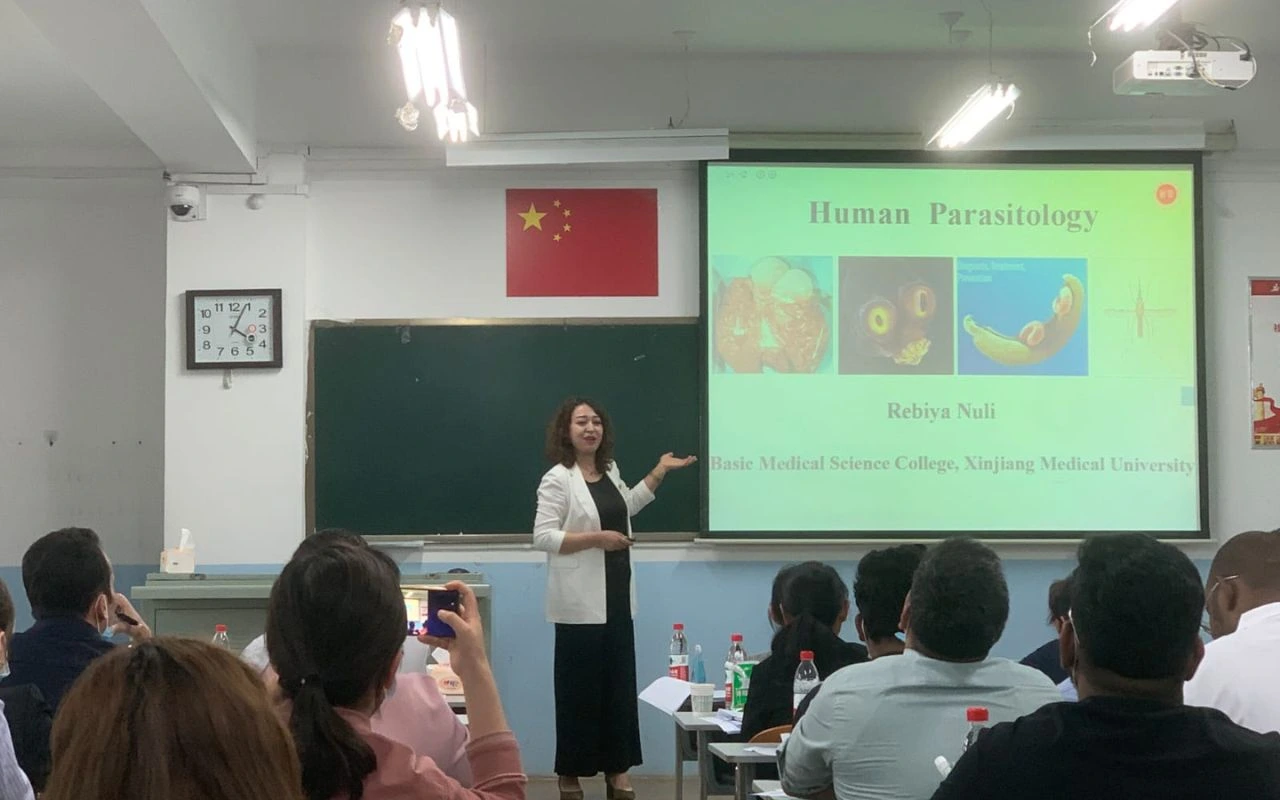
Both routes are taught in English. The difference appears in the clinical years. In Pakistan, you will talk to patients in Urdu or a regional language that you already speak. In China, the lectures are in English, but the patients in the teaching hospitals speak Chinese.
That is why XJMU teaches introductory Chinese in years 1 and 2 and requires HSK-4 proficiency by graduation. Students who attend the classes and practise daily reach the level, but it is real work on top of a heavy science timetable. For a student who is not willing to learn a new language, this is the strongest argument for staying at home.

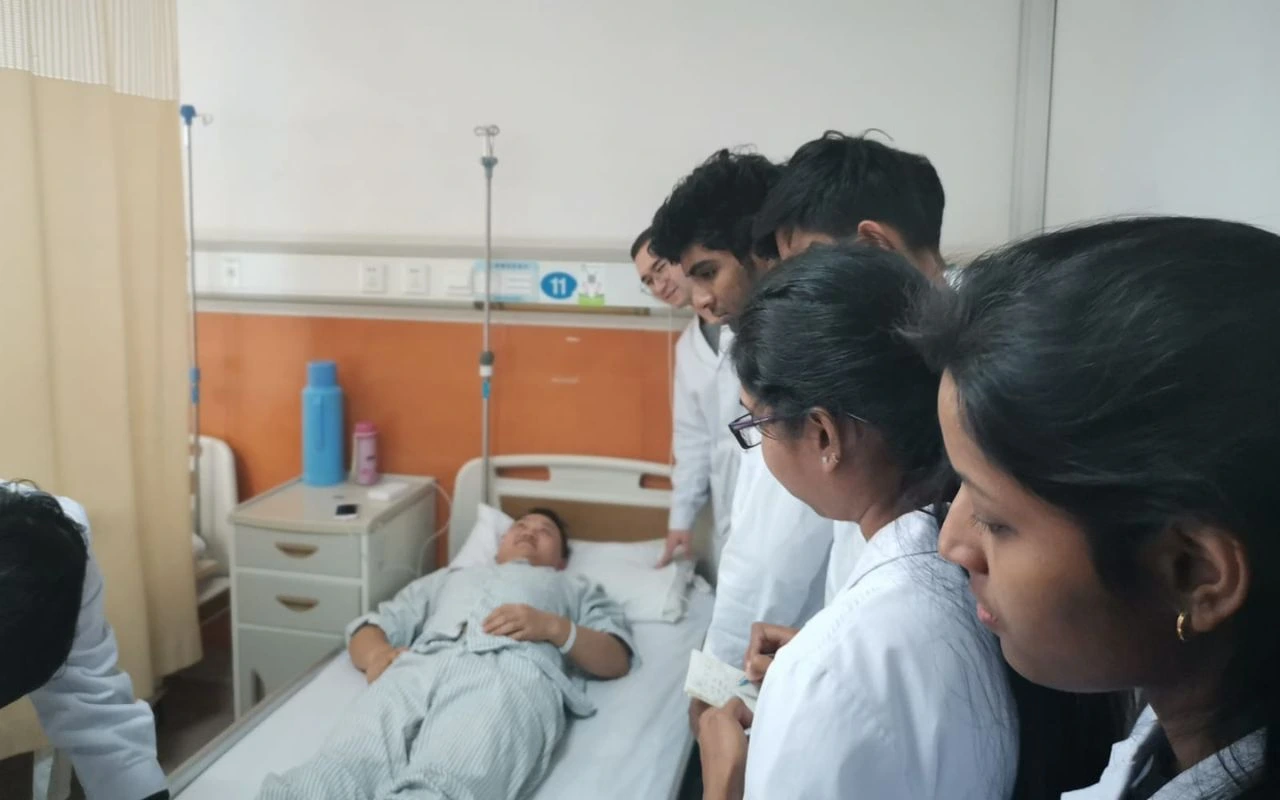
The strength of a medical degree is the patients you learn from. Xinjiang Medical University has 8 directly affiliated hospitals. The First Affiliated Hospital is the largest, and it is a Class A tertiary hospital, the highest grade in China's hospital system. From year 4, teaching is at the bedside, and in year 6 you rotate through the main departments under supervision for a full year.
The caseload in a Chinese teaching hospital differs from the one in a Pakistani hospital. Some diseases are more common in one country than the other, and the systems for referral and records are different. Students who plan to practise in Pakistan should deliberately build familiarity with the conditions and practice patterns they will meet at home, during their elective time and while preparing for the licensing examination.
A medical degree is only useful if it leads to a licence. Recognition has three layers, and different bodies decide each one.
A student who graduates from a Pakistani medical college is registered through the regulator's normal route and does not take the examination that foreign graduates take. That is a real advantage, and families should count it.
Graduates of XJMU are eligible to appear for the licensing examinations of their home countries and for international examinations such as the USMLE. The conditions, fees and attempts allowed for the home examination are set by the regulator. Read them on the regulator's own website, not in an agent's summary.
These are the reasons students choose China, and they are all real. They are also not the whole picture.
Most websites that sell MBBS in China list only advantages. These are the disadvantages a student should weigh, and none of them is a reason to avoid China by itself. Together they are a reason to decide carefully.
Ask each family member to tick the disadvantages they can live with. If the language, the distance and the extra examination are all acceptable, China is a serious option. If two of them are not, a seat at home deserves a harder look.
It is worth it for a particular kind of student. That student has the marks to qualify, understands that the degree is six demanding years, is prepared to learn Chinese, has a budget that covers the whole cost including the licensing examination, and has checked the regulator's rules in advance.
It is not worth it as a last-minute escape from a failed entrance test, and it is not worth it if the only reason is that an agent said so. The students who regret the choice are usually the ones who did not read the licensing rules, did not budget for the full period, or did not realise how much Chinese they would need.

If you can say yes to each of the following, China is worth a serious application: I meet the 60% requirement in each science subject. I have checked that the university is on the MOE list. I have read the regulator's current rules. I can fund six years. I am willing to learn Chinese. I want to be a doctor and not just to hold a degree.
Every family is different, but most students fall into one of a few situations. These are not rules. They are a way to start the conversation at home.
This student has the 60% in each science subject and the ability to study in English. China is a realistic option, particularly if the family can fund six years and the student is willing to learn Chinese. Waiting a year for another attempt at home is the alternative, and the family should weigh a lost year against the extra months of the China route.
Compare the whole six-year figure with the whole cost at home, using the worksheet, and include flights and the licensing examination. A published, all-inclusive first year helps planning, but the family should be sure it can fund every year before starting.
Living abroad for six years, in a second language and a cold climate, is hard for some people. If the thought of it is stressful, a seat at home deserves more weight, whatever the cost.
Graduates of XJMU are eligible to sit international examinations such as the USMLE, subject to the conditions of each examining body. For a student who plans to work in another country, the home regulator's rules matter less, and the target country's rules matter more. Read those first.
Keep the written answers. If anyone is reluctant to put figures or promises in writing, treat that as information.
China is one of several countries where Pakistani students study medicine. Whichever one you consider, apply the same three checks: is the programme approved where it is taught, is the school in the World Directory of Medical Schools, and does your own regulator allow its graduates to sit the licensing examination.
For China, the first check is public. The MOE notice of 1 June 2026 approves 43 universities and 2,790 seats for 2026–2027. Universities outside the list may admit international students only to Chinese-medium clinical medicine and may not issue an English-language MBBS certificate. Never rely on a brochure to tell you which side of that line a university is on.
Source: Ministry of Education of the People's Republic of China, notice 教外司来〔2026〕94号, issued 1 June 2026.
Check all 43 MOE listed universitiesA good decision takes a few weeks. A rushed one can take years to undo.
| Step | Fall intake (September) | Spring intake (February/March) |
|---|---|---|
| Applications open | 1 March | 1 September |
| Early deadline (recommended for scholarships) | 30 June | 15 December |
| Regular deadline | 15 August | 15 January |
| Registration and orientation | 10 September | 20 February |
Everything a Pakistani student and family need to decide on an MOE listed MBBS in China: eligibility after FSc, fees, intakes, travel from Islamabad, recognition at home and how to apply to Xinjiang Medical University.
The complete guide to studying MBBS in China in 2027: who can apply, which universities are MOE listed, what an English taught MBBS costs, and how to prepare an application to Xinjiang Medical University (XJMU).
The 43 universities that China's Ministry of Education has approved to teach MBBS in English to international students, with seat quotas, the rules behind the list and how to check any university yourself.
Talk to our admissions counsellors for free guidance, or start your application online.