Some adverts say no HSK is needed, some say HSK-4 in the first year, some say HSK-4 for the degree. This guide explains why they differ, what applies at Xinjiang Medical University, and how to prepare, year by year.
No Chinese is needed to apply to or be admitted at Xinjiang Medical University. The MBBS is taught and examined entirely in English. Introductory Chinese is taught in years 1 and 2, and HSK-4 is required by graduation, because patients in the teaching hospitals speak Chinese. Other universities set their own rules, so ask each in writing.
| Chinese to apply | None needed |
|---|---|
| Language of teaching and exams | English |
| Chinese classes | Introductory Chinese in years 1 and 2 |
| HSK-4 | Required by graduation |
| HSK exam fee | Extra cost paid by students (see living costs in the fees guide) |
| MOE status | Listed, 8th of 43 universities; 60 seats (MOE notice, 1 June 2026) |
| Duration | 6 years including a 1-year internship |
| Intakes | March/Spring and September/Fall |
Search for HSK and MBBS in China and you will find answers that seem to contradict each other. One page says you need no HSK at all. Another says you must pass HSK-4 in your first year. A third says HSK-4 is needed before you can graduate. Parents reading all three reasonably conclude that someone must be wrong.
In most cases nobody is exactly wrong. The three statements describe three different moments in the life of a student: the moment you apply, the moment you are studying, and the moment you graduate. A page that only talks about the application will say that no HSK is needed. A page that only talks about the course will say that Chinese is taught. A page that only talks about the degree will say that a level is required. Each is a true sentence about a different point in time, and each leaves out the other two.
The second reason is that universities really do set their own rules. The Ministry of Education decides which universities may teach the English taught MBBS, but each one decides how its Chinese teaching is organised and what level it asks for. So what is true at one university may not be true at the next. This page does not guess about other universities. It explains what applies at Xinjiang Medical University (XJMU) and gives you three questions to put to any other programme.
If you want the short version of how the English taught MBBS works as a whole, read our guide to the English taught MBBS first. This page goes deeper on one subject only: Chinese, HSK and how to prepare.

The position at Xinjiang Medical University is simple, and it is the same for every international MBBS student. You do not need any Chinese to apply and you do not need any to be admitted. The MBBS is taught and examined entirely in English. Introductory Chinese is taught in years 1 and 2. HSK-4 is required by graduation.
Put in one line, the sequence is: no Chinese to start, Chinese lessons in the first two years, HSK-4 before you leave. Nothing about your admission depends on a Chinese test, and nothing about your English-language lectures or examinations is conducted in Chinese.
The reason is practical rather than bureaucratic. Patients in the teaching hospitals speak Chinese. A doctor who cannot ask where it hurts, how long it has hurt and whether the patient is allergic to any medicine cannot take a history, and taking a history is the first skill of clinical medicine. The language requirement exists so that you can do that part of the job.
| Stage | What applies |
|---|---|
| Applying and admission | No Chinese needed |
| Lectures and examinations in the medical subjects | Entirely in English |
| Years 1 and 2 | Introductory Chinese is taught |
| Clinical years and the internship | Patients speak Chinese, so you use it at the bedside |
| Graduation | HSK-4 is required |
| HSK examination fee | An extra cost paid by students, listed under living costs in the fees guide |
Almost every page about this subject uses one of three sentences. Here is each one, the moment it usually describes, and what it leaves out.
Read the three as a timeline. First you apply, with or without Chinese. Then you study, with classes or without. Finally you graduate, with a level or without. A university can be strict at one point and relaxed at another, and an honest description tells you about all three.
At XJMU the answers are: nothing at the start, classes in years 1 and 2, HSK-4 by graduation. If an advert from any university gives you only one of the three, ask for the other two in writing.
A claim such as "you will never need Chinese" or "Chinese is impossible for medical students" is a warning sign. Both are wrong in the same way. They ignore the point that medicine is practised with patients, and that in China the patients speak Chinese.
| What you read | The moment it usually describes | What it leaves out |
|---|---|---|
| "No HSK required" | Applying and being admitted | Chinese is still taught during the course and a level is asked for later |
| "HSK-4 in the first year" | A rule some programmes set early in the course | Whether a lower level is acceptable at first, and what happens at graduation |
| "HSK-4 needed for the degree" | Graduating | That you can start from zero and are taught the language on the way |
HSK is the standard test of Chinese language proficiency for people whose first language is not Chinese. It is run by Chinese Testing International, which grew out of the organisation known as Hanban. Universities, employers and scholarship bodies in China use it as the common measure of how much Chinese a person can handle.
The test is divided into levels, from beginner upward. Level 4 is a middle level. In general terms it corresponds to being able to discuss a fairly wide range of everyday topics and to communicate in ordinary situations. That is a useful description for a medical student: it is the level at which you can have a real conversation with a patient about how they feel.
HSK has been revised over the years, and the number of levels, the content of each level and the format of the test have changed. For that reason this page does not quote word lists, pass marks, fees or test dates. Check the current HSK description on the official site, chinesetest.cn, and ask the international student office which version of the test applies to you and where it is held.
Passing a level does not by itself make you good at speaking Chinese to patients. HSK tests general language. The phrases in the clinic section below are not tested, but you will use them every day in the wards. Treat the test as a record of your progress and the clinic Chinese as the real goal.
The HSK examination fee is an extra cost that students pay themselves. It is listed under living costs in our fees guide, and no amount is stated there or here, because the fee is set by the test provider and can change. Budget for it as a small, separate item and confirm the current figure when you register.
Fees and living costsThe plan below is a general guide, not a timetable. It does not state class hours, because the university sets those. It shows how a student who starts from zero can move steadily towards HSK-4 without letting Chinese crowd out anatomy.
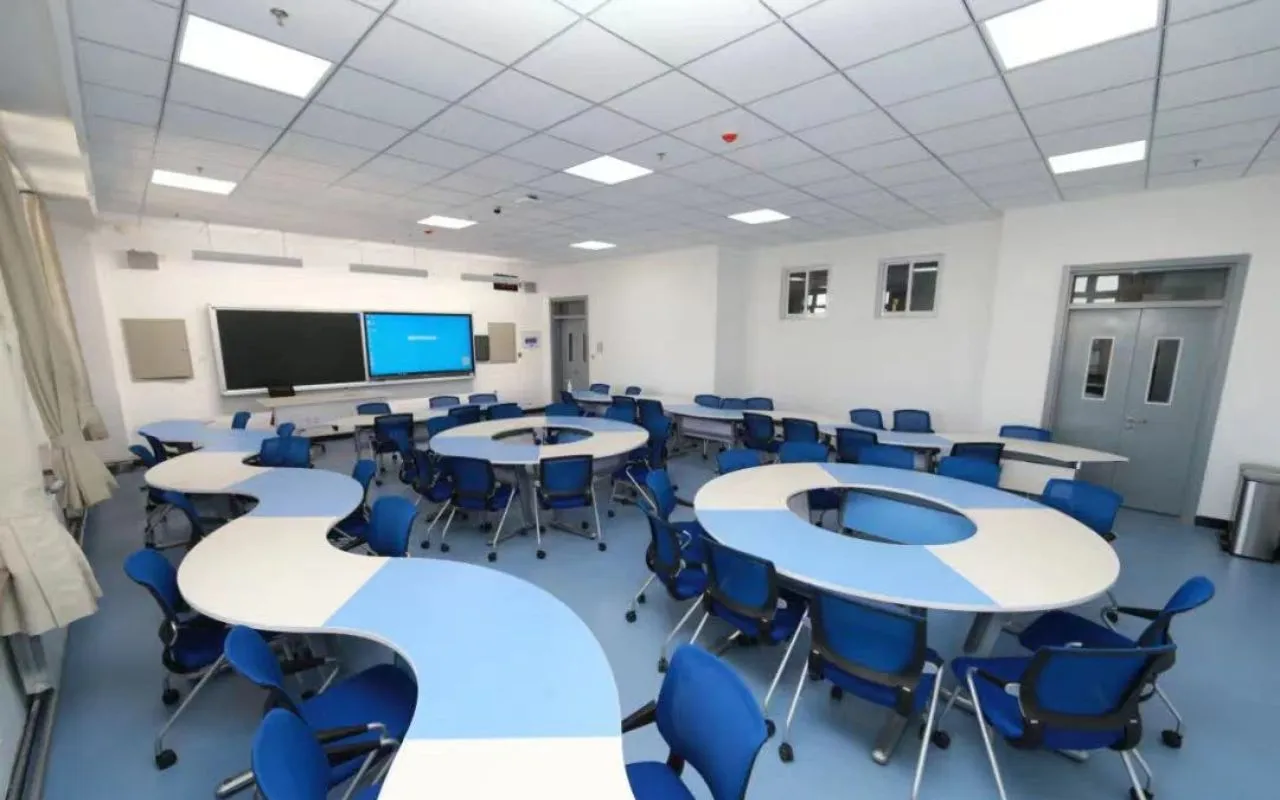
Learn to read pinyin and to pronounce the four tones. Learn greetings, numbers, days of the week and a few polite phrases. You are not trying to finish a course. You are trying to arrive with your ears and mouth already used to the sounds.
Attend every class in the first semester. Use Chinese for food, transport, shopping and greetings, even when it is clumsy. Learn pinyin properly and a first set of characters. In this year the aim is confidence, not speed.
Move from daily life to the body. Learn the names of body parts, common symptoms and the words for time and frequency. This is the year in which the introductory classes finish, so make sure you leave them with reading and listening you can actually use.
The third year is heavy on pathology and pharmacology, and Chinese is the first thing students drop. Do not. Keep a small daily habit, and begin to prepare for the HSK-4 test with past-style practice material. A student who stops for a year loses more than a year of progress.
Teaching moves to the bedside. Now the phrases for taking a history become real. Practise them with classmates, then use them with patients under supervision. Each ward visit is also a listening lesson.
Sit HSK-4 if you have not already. Do not wait for the last moment: a result that is already in hand takes a weight off the internship year. Continue to build vocabulary for examination, investigations and treatment.
Rotations across the major departments will give you more Chinese practice than any classroom. Keep a notebook of new words from each department. If HSK-4 is still outstanding, it must be finished by graduation, so treat it as a deadline and not a hope.
Life in Urumqi for international studentsThese short phrases cover greeting a patient, asking about symptoms and taking a simple history. They are in standard Mandarin with pinyin tone marks. Your Chinese teachers will correct your pronunciation, and in a hospital patients may use local words, so treat this list as a starting set and have a teacher check how you say each one.
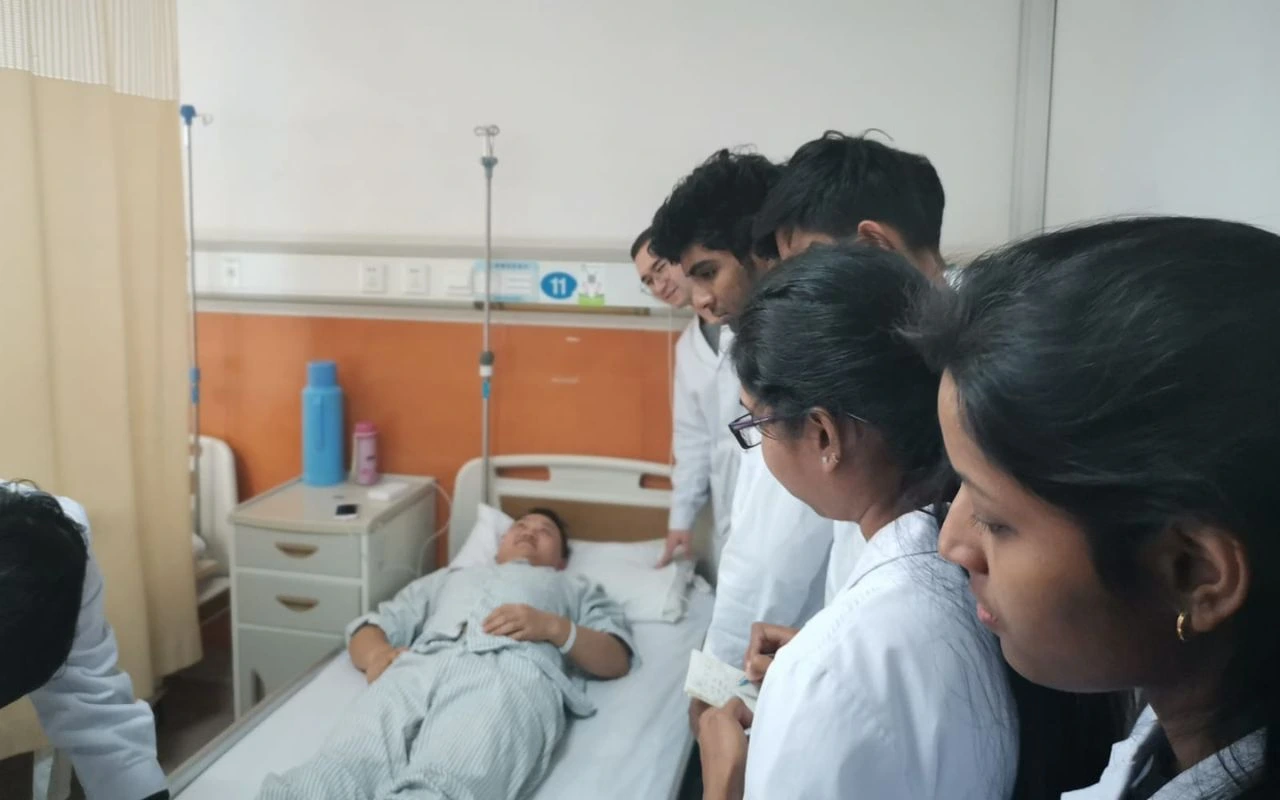
Learn each phrase with its answer. If you ask where it hurts, you must understand the reply, and replies are harder than questions because patients do not speak slowly. Ask your teacher to say each phrase at normal speed, and record it on your phone.
Say each one aloud until it is automatic. Practise in pairs, with one student as the doctor and one as the patient. This is the easiest way to prepare for the first bedside session, and it costs nothing.
Use nín, the polite form of you, with older patients. Smile, speak clearly and thank the patient. A patient who sees that a student is trying hard to speak Chinese is usually patient in return.
| Pinyin | English meaning |
|---|---|
| Nǐ hǎo. Wǒ shì yīxuéshēng. | Hello. I am a medical student. |
| Nǎr bù shūfu? | Where do you feel unwell? |
| Nǎr téng? | Where does it hurt? |
| Téng duō jiǔ le? | How long has it hurt? |
| Cóng shénme shíhou kāishǐ de? | When did it start? |
| Téng de lìhai ma? | Is the pain severe? |
| Nǐ fāshāo le ma? | Do you have a fever? |
| Nǐ késou ma? | Do you have a cough? |
| Nǐ ǒutù le ma? | Have you been vomiting? |
| Nǐ duì yào guòmǐn ma? | Are you allergic to any medicine? |
| Nǐ zài chī shénme yào? | What medicine are you taking? |
| Qǐng shēn hūxī. | Please breathe deeply. |
| Qǐng tǎng xiàlái. | Please lie down. |
| Wǒ yào liáng yíxià xuèyā. | I am going to measure your blood pressure. |
| Wǒ tīng yíxià nǐ de xīnzàng. | I will listen to your heart. |
| Qǐng zài shuō yí biàn. | Please say that once more. |
| Qǐng shuō màn yìdiǎnr. | Please speak a little more slowly. |
| Xièxie nín de pèihé. | Thank you for your cooperation. |
Medical students are busy, so the best methods are small, regular and tied to what you already do. These habits are the ones students pass on to juniors.
Fifteen minutes every day does more than three hours on Sunday. Language is learned by repetition spread across weeks. Put a short Chinese session in the same slot each day.
Pinyin is the spelling system for pronunciation, and tones change the meaning of a word. Learning them badly in the first month creates habits that are hard to undo.
Choose vocabulary from your own day: the canteen, the bus, the ward. Words you use come back easily. Words from a list you never use disappear.
A flashcard app helps with words, but it does not teach you to understand speech. Add short listening practice every day, with a native speaker where you can.
Talk to shop owners, drivers and Chinese classmates. Mistakes are normal and most people enjoy helping a student who tries.
Write down every word you hear in a hospital, with the pinyin and the English meaning. A notebook of real words is the most valuable thing you will have in year 6.
Students in higher years know which teachers, books and apps help, and how they prepared for HSK. Ask them early.
Most Chinese problems that students meet in the clinical years began as a decision in the first year.
This is not an official test and it does not give you an HSK level. It is a quick way to see where you are and what to do next. Be honest with yourself.
You are a beginner, and that is normal for almost every applicant. Start with pinyin, tones, greetings and numbers. You have time, and the university teaches Chinese from the first year.
You are ready to learn faster. Say your name, greet someone, count to one hundred, ask the price of something, and name five foods in Chinese. Build from there into the body and symptoms vocabulary.
Look at the current HSK description on the official site and try a practice paper at the level you think you have reached. Use the result to see which skill, listening, reading or characters, needs work. An early result is useful but not required for admission at XJMU.
Other programmes set their own rules, and this page does not describe them. What you can do is ask each university the same three questions, in writing, before you pay anything. Written answers can be compared and kept.
Save the replies next to the offer letter. If a university answers one question and ignores the others, ask again. A clear programme will answer all three without difficulty.
Chinese language rules matter, but they come after the basic question of whether the university is allowed to teach the English taught MBBS at all. Check that first on the Ministry of Education list.
See the MOE list of 43 universitiesParents often worry that their child will struggle because of the language. These points are what most families need to know.
There is no Chinese entry test and no HSK certificate required for admission to the English taught MBBS at XJMU. Your child will study medicine in English and learn Chinese in classes alongside it.
HSK-4 is required by graduation, so Chinese is part of what your child must achieve to finish. It is better to say this clearly now than to let it surprise your family in year 5.
Encourage a daily habit before departure. Ask your child to teach you a Chinese phrase each week, because teaching helps learning. Do not push for results too early. Steady progress is better than a rush.
The first-year package is ¥49,950 and each later year is about ¥35,950. The HSK examination fee is an extra cost that students pay. It sits under living costs in the fees guide, and you should budget a little for it. The university has confirmed that fees for the 2027 intakes are the same as for 2026.
Ask about attendance in the Chinese classes, class test results and when the HSK test is planned. Those three answers tell you more than any marketing page.
You do not have to arrive speaking Chinese, but a little preparation makes the first weeks easier. This is a checklist of what is worth doing before you board.
XJMU has a March/Spring intake and a September/Fall intake. If you are joining the September/Fall intake you have time to start learning in the summer. If you are joining the March/Spring intake, start as soon as you receive your admission letter.
Do not spend money on an expensive course before you arrive. A free pinyin course and a few hours a week are enough, because the university teaches the rest.
Student visa guide for MBBS in ChinaChinese makes more sense when seen next to the rest of the programme. XJMU is number 8 of 43 on the Ministry of Education list of 1 June 2026, with 60 seats for international students. The MBBS lasts six years, including a one-year internship, and there are two intakes a year: March/Spring and September/Fall.
The first-year package is ¥49,950, which covers application processing, tuition, hostel, the visa, health insurance, the JW202 letter and airport pickup. From the second year the cost is about ¥35,950 a year. The HSK examination fee is separate and paid by the student.
| Question | Answer |
|---|---|
| Language of teaching and examinations | English |
| Chinese to apply | None needed |
| Chinese classes | Introductory Chinese in years 1 and 2 |
| HSK-4 | Required by graduation |
| Duration | 6 years including a 1-year internship |
| MOE list position | Number 8 of 43, 60 seats |
| Intakes | March/Spring and September/Fall |
Source: Ministry of Education of the People's Republic of China, notice 教外司来〔2026〕94号, issued 1 June 2026.
You can apply for the XJMU MBBS today without any Chinese. Choose your intake, prepare your documents and send your application. The admissions team can answer your questions about Chinese in writing, so that you have the answers on record before you decide.
| Step | September/Fall intake (September) | March/Spring intake (February/March) |
|---|---|---|
| Applications open | 1 March | 1 September |
| Early deadline (recommended for scholarships) | 30 June | 15 December |
| Regular deadline | 15 August | 15 January |
| Registration and orientation | 10 September | 20 February |
How an English taught MBBS works at an MOE listed university: who is allowed to teach it, what you study each year, how much Chinese you need, and what it costs at Xinjiang Medical University.
What daily life is like for an MBBS student in Urumqi: the city and its climate, the hostel, halal food, monthly costs, transport, phones and money, clothing for each season, and a first-month plan for new arrivals and their parents.
A clear breakdown of what an MBBS in China costs at Xinjiang Medical University, an MOE listed university: the first-year package, the yearly fees after that, the payments you make before you travel, everyday living costs and a six-year total you can check yourself.
Talk to our admissions counsellors for free guidance, or start your application online.